“Burnt Out” is an interactive experience merging psychology with Vietnamese temple traditions to navigate modern exhaustion. Within an immersive sanctuary, the audience identifies their specific burnout type, each manifested as a symbolic creature rooted in cultural imagery.
Whether facing "Compassion Fatigue," "Toxic Positivity," or "Social Noise," participants confront their habits through reflective scenarios. The journey culminates in a personalized talisman, such as Sincere Ties or Trust Release, serving as both a spiritual affirmation and a practical tool for self-preservation. By making invisible struggles visible, the project transforms burnout into a guided path toward balance, pacing, and cultural reconnection.
The flow of the exhibition is: 1. Personality Quiz, 2. Find Your Talismans, and 3. Fortune Telling.
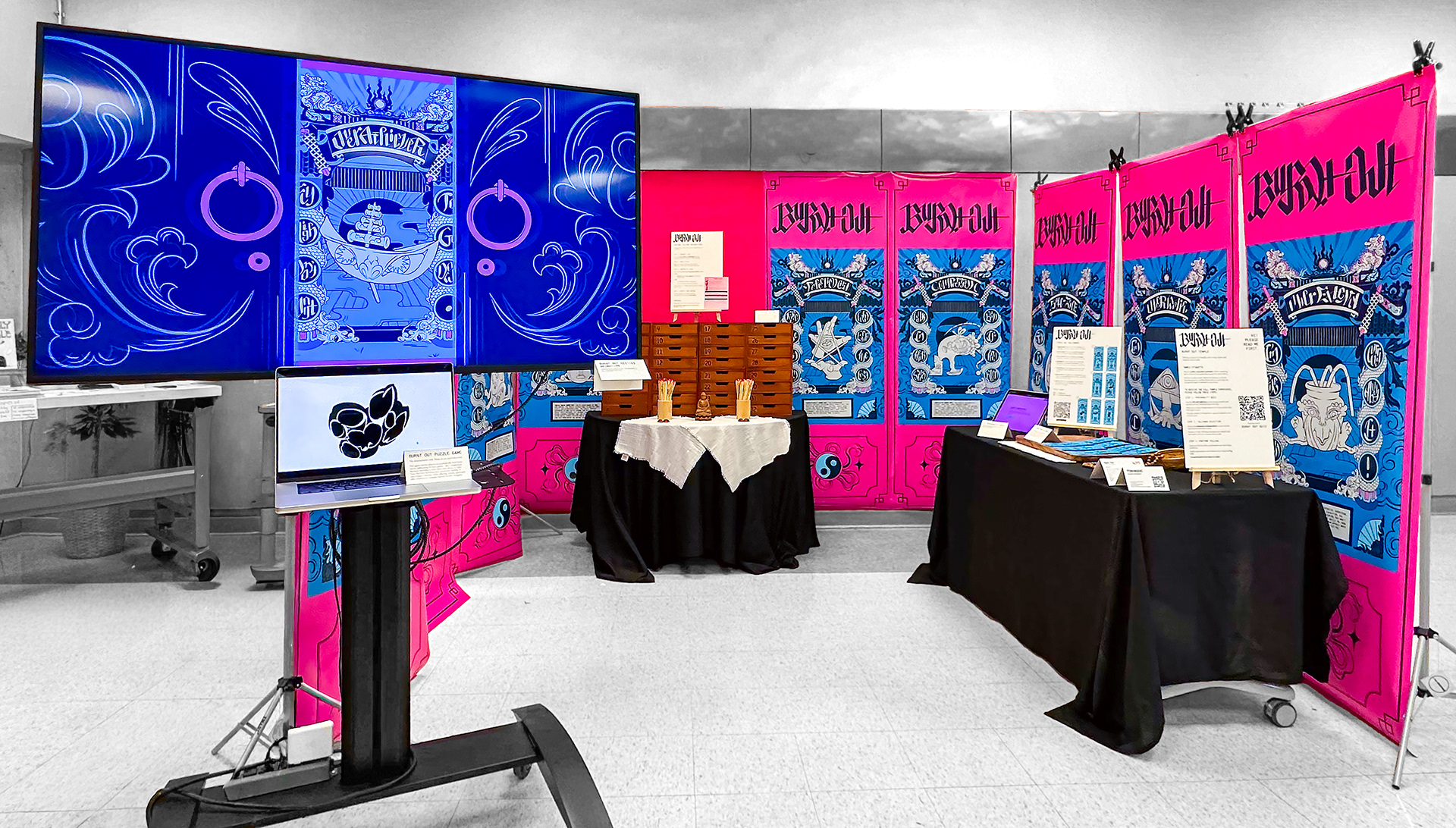
Upon doing research of how many types of burnout: overload, under-challenged, and neglect. From the original 3, I branched out into more personal detailed types, including Compassion BO, Invisible BO, Morality BO, Overachiever BO, Overextend BO, Overwork BO, Perfectionist BO, Safe-Zone BO, and Social Noise BO.
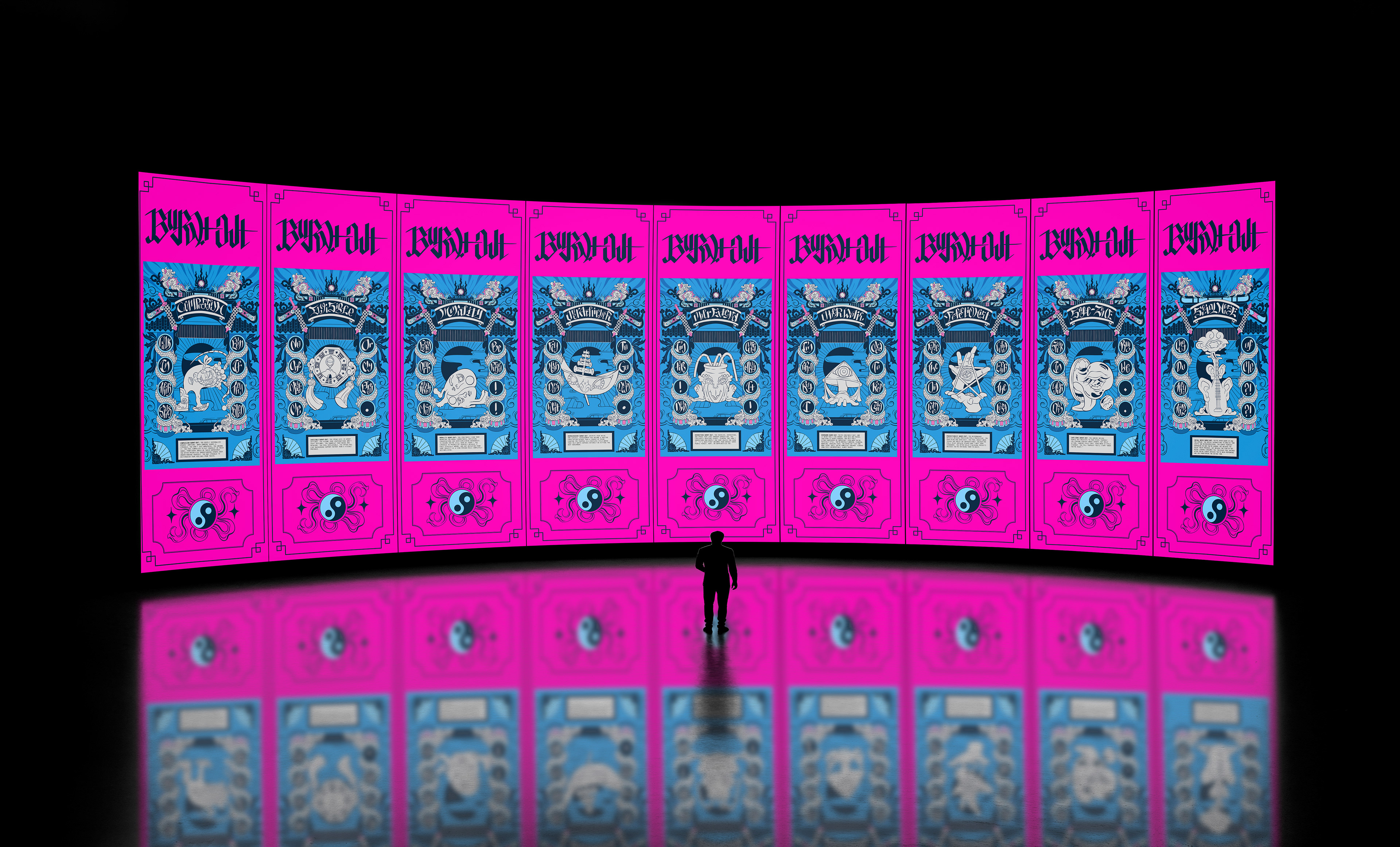
The character designs are heavily inspired by Vietnamese culture and symbolism. Compassion Burnout references Hát Bội (Vietnamese opera), representing constantly stepping into other people’s shoes until you forget your own. Invisible Burnout appears as a ghost trapped inside a Bagua mirror, while Morality Burnout draws from Yin and Yang, with Yang suppressing Yin. Overachiever Burnout takes the form of a flute kite, Overextend Burnout references Rượu Cần, where many people drink from the same communal wine jar, and Overwork Burnout uses the Nón Lá to reference exploited farmers during the colonization era. Perfectionist Burnout is inspired by Vietnamese string figures, Safe-Zone Burnout is trapped inside its own bubble, and Social Noise Burnout takes the form of a Đàn Tỳ Bà (lute).
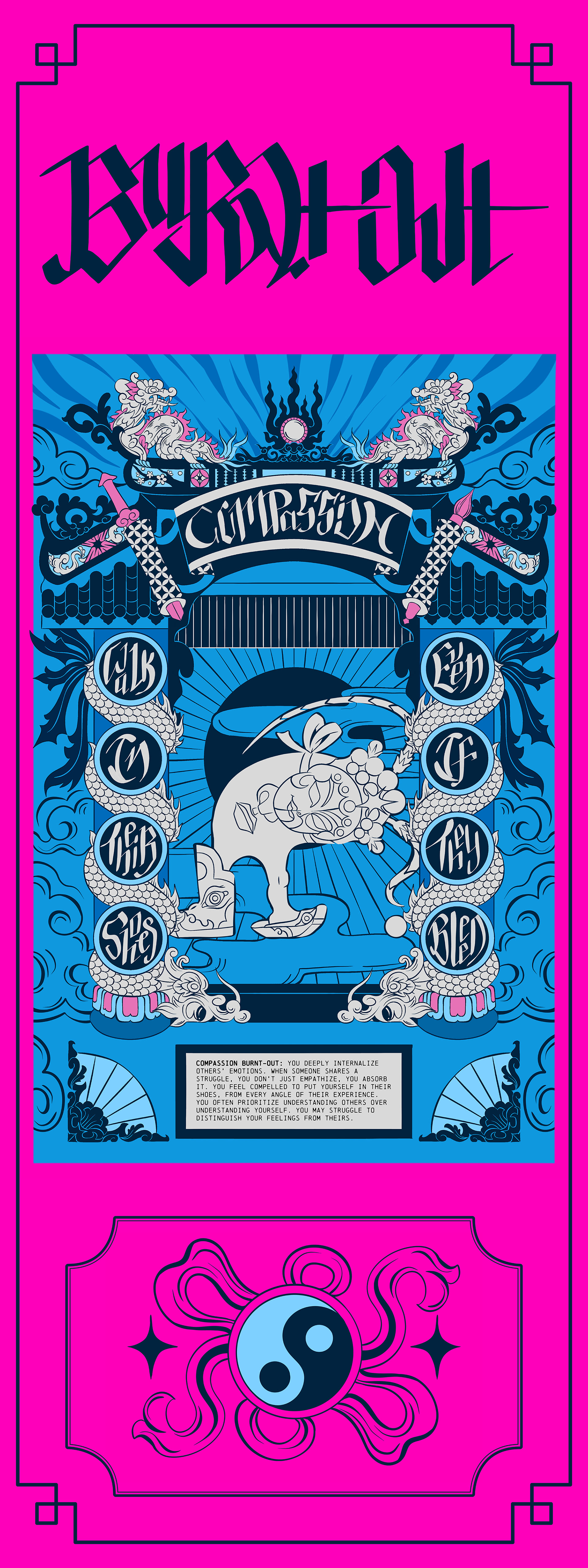
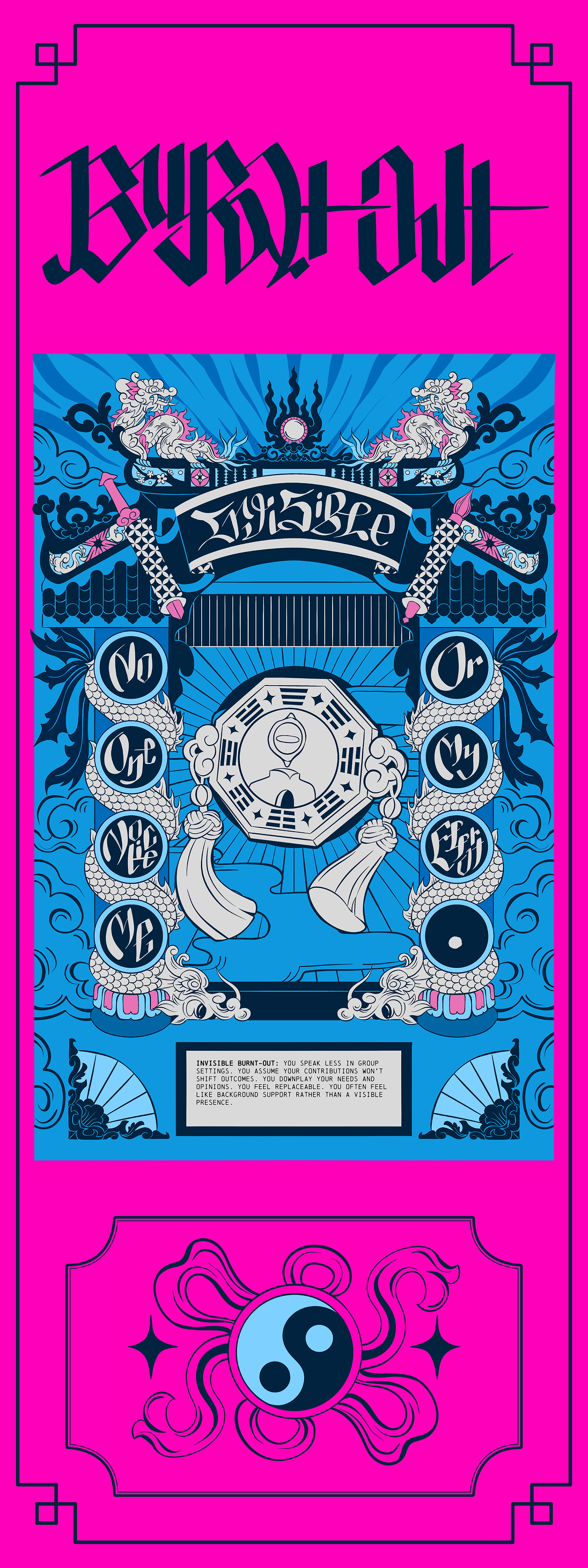
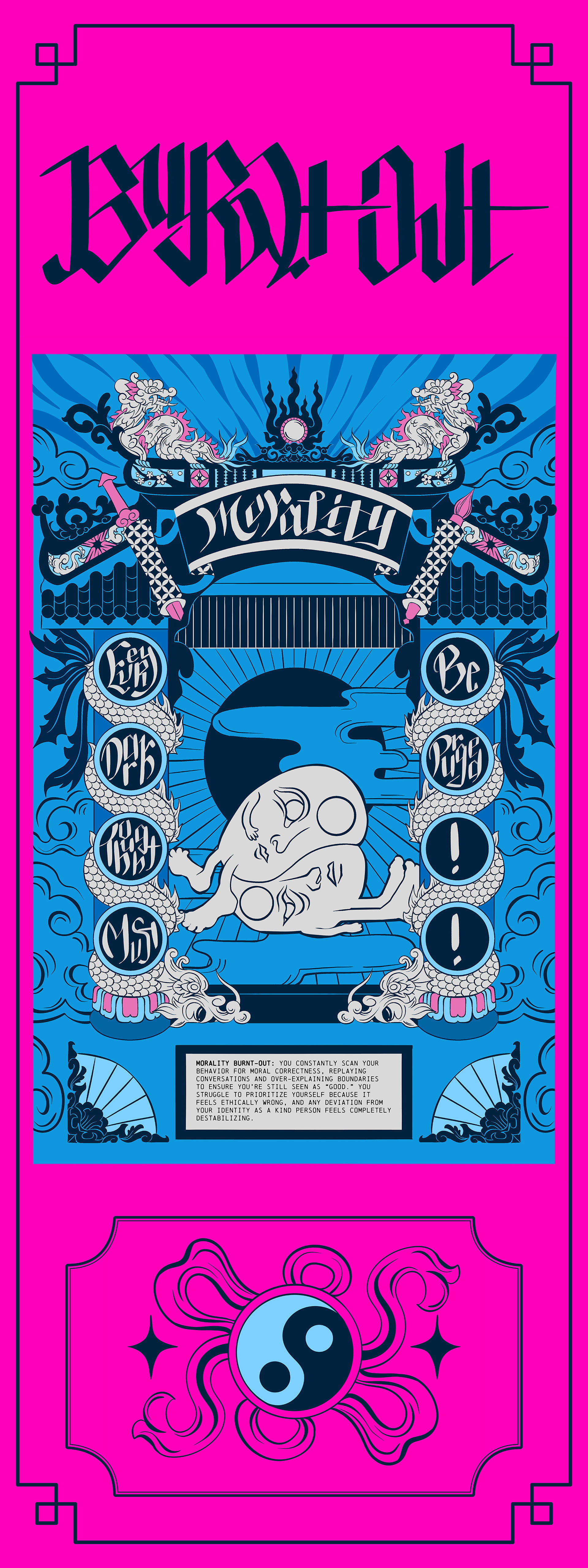
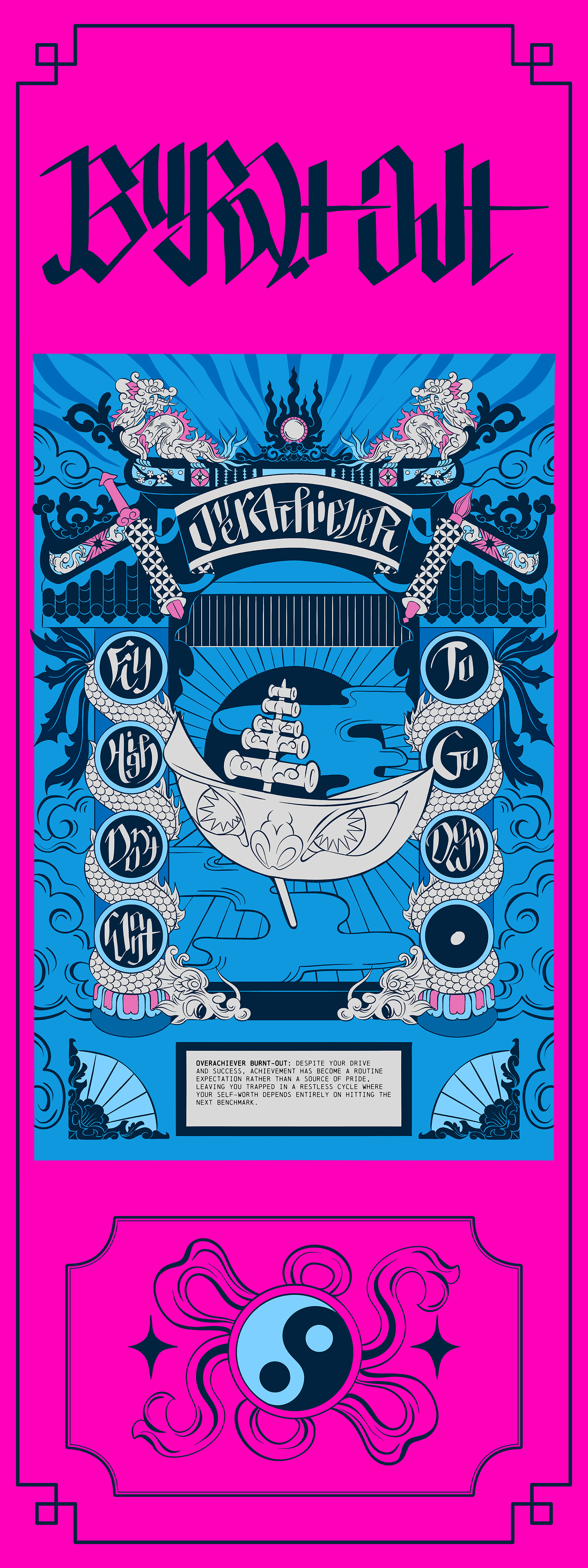
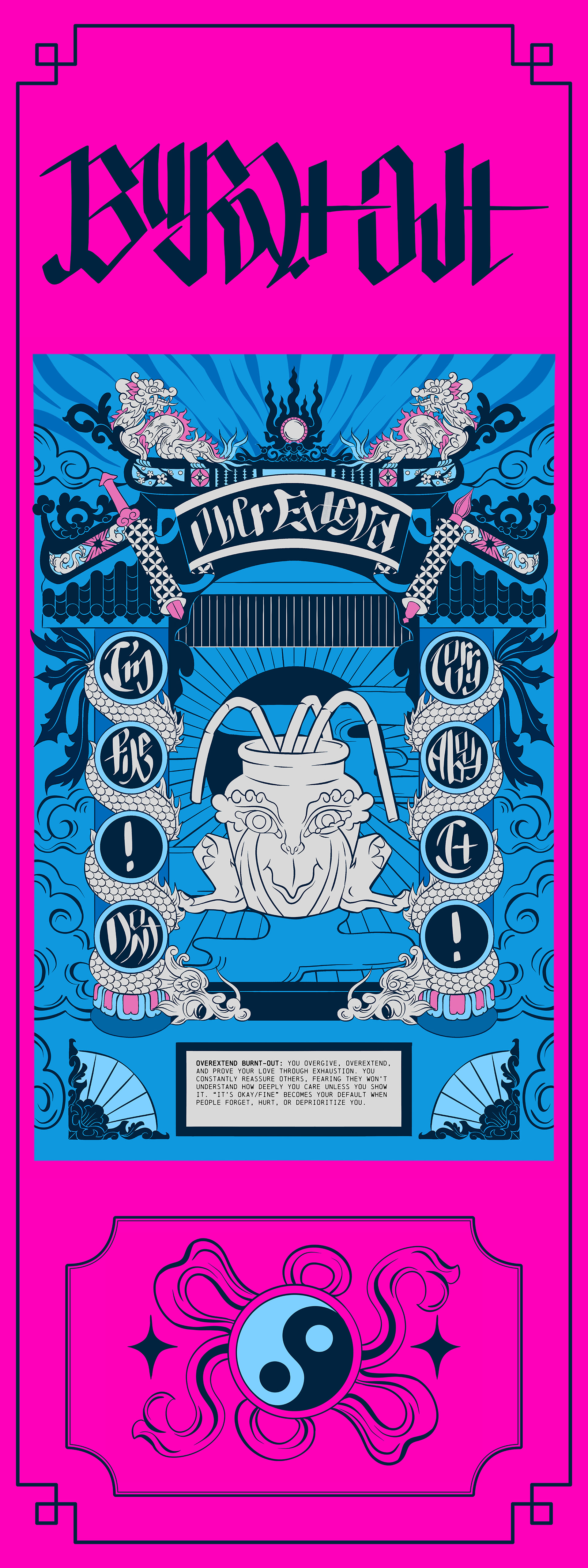
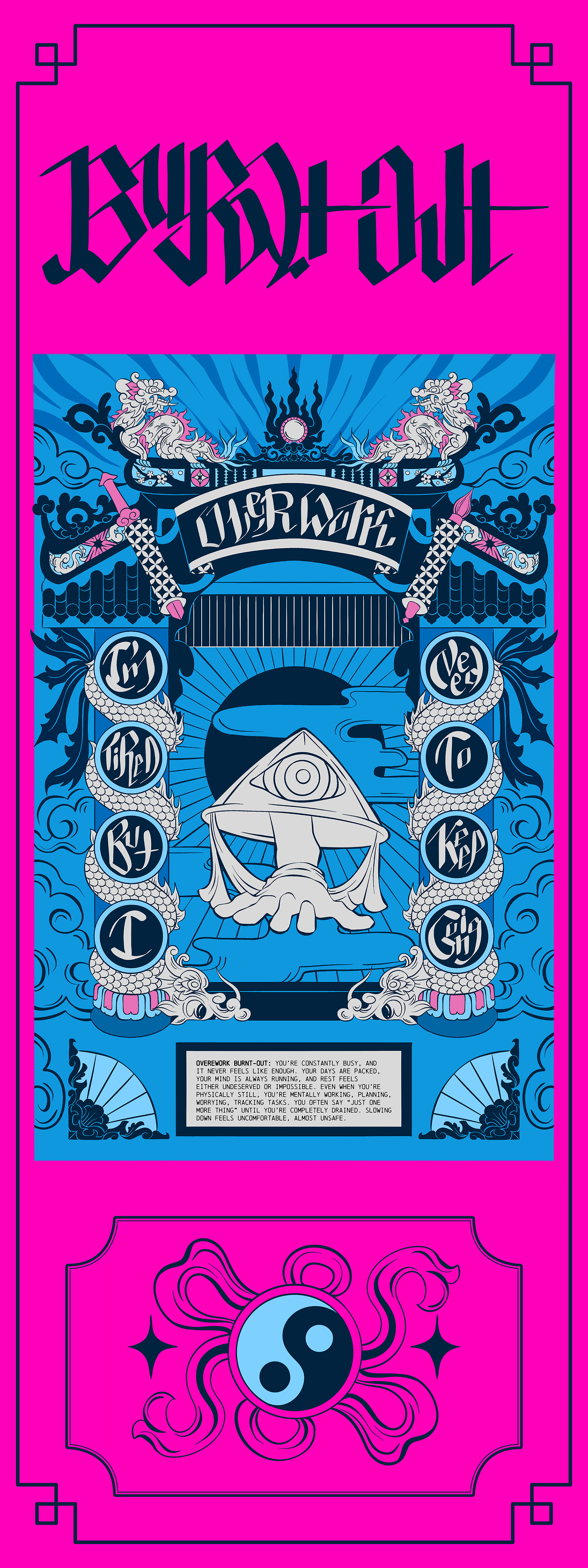
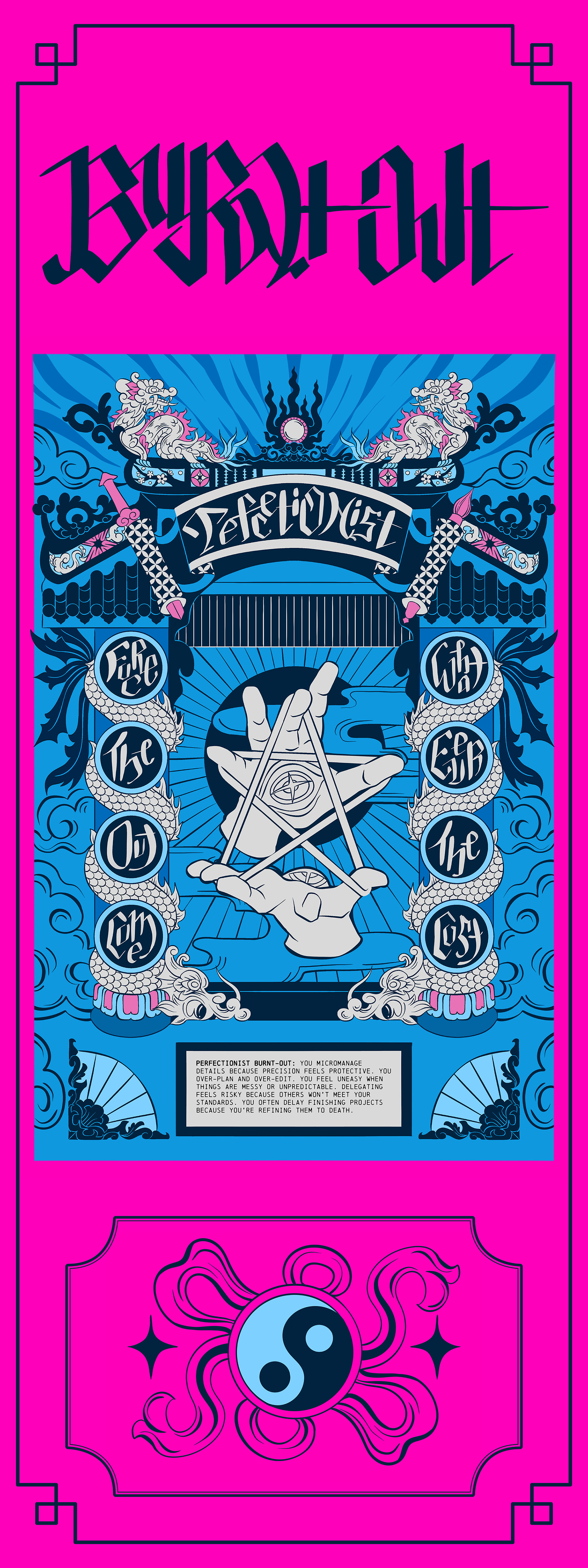
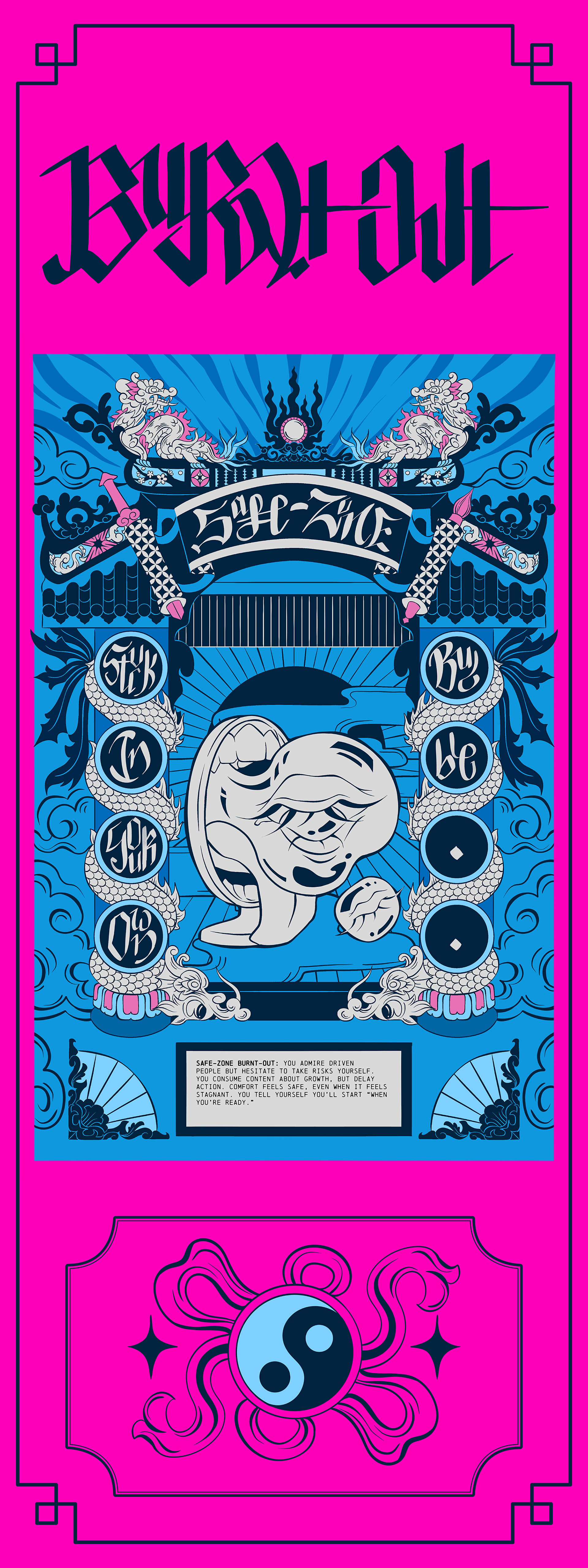
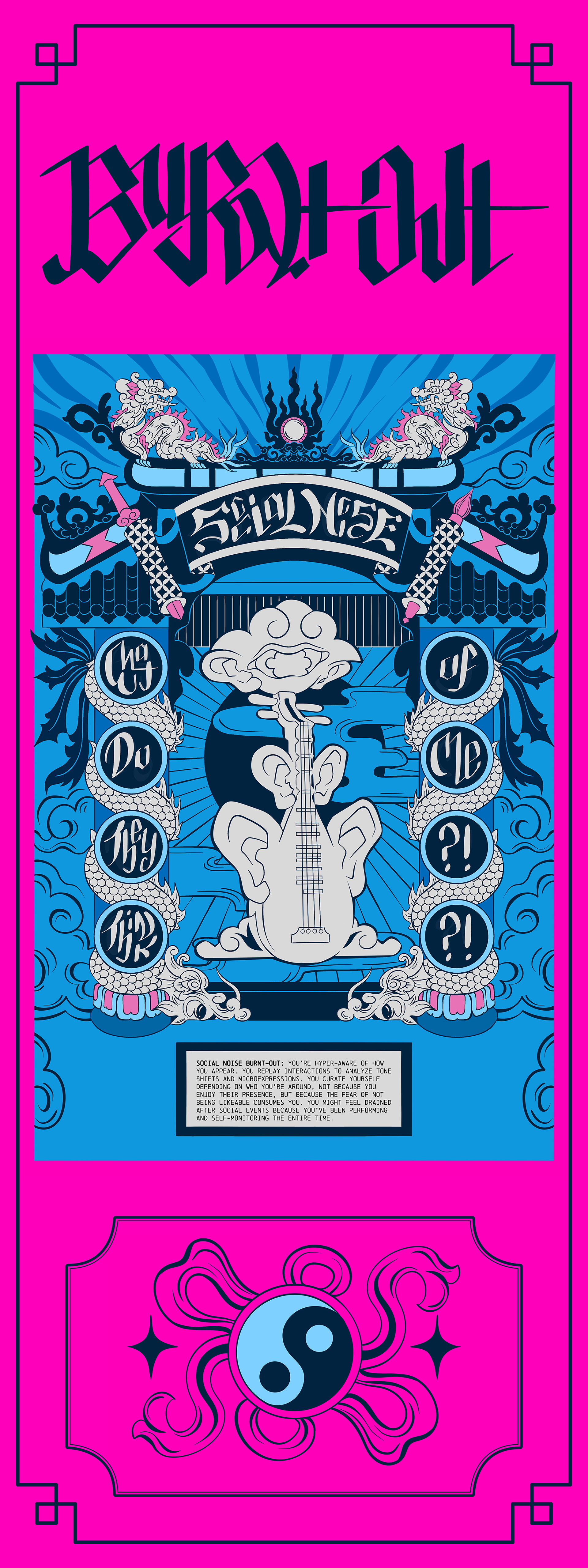
The architecture and sculptures of the Huế Imperial Palace, on top of joss paper's design and other Vietnamese temple's architecture, deeply influenced the design of the Burnt-Out Temple’s gate. To mirror this visual heritage, the animation features traditional Huế Royal Court Music (Nhã nhạc). The soundtrack includes Ngũ đối thượng - Ngũ đối hạ (The Five Higher and Lower Matched Melodies), Long Ngâm (The Roar of the Dragon), and Thập Thủ Liên Hoàn (The Ten-Piece Connected Suite).
STEP 1: Personality Quiz
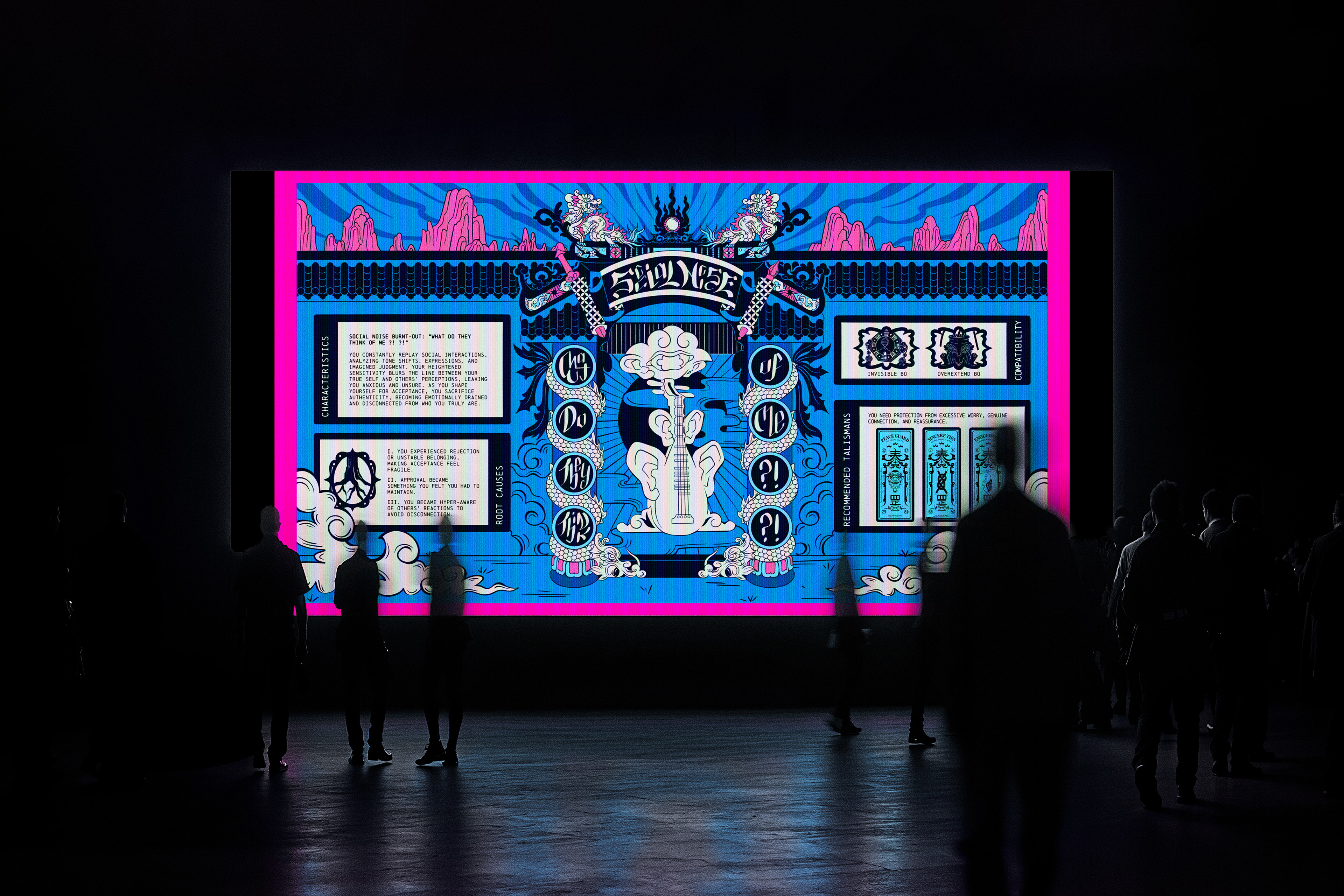
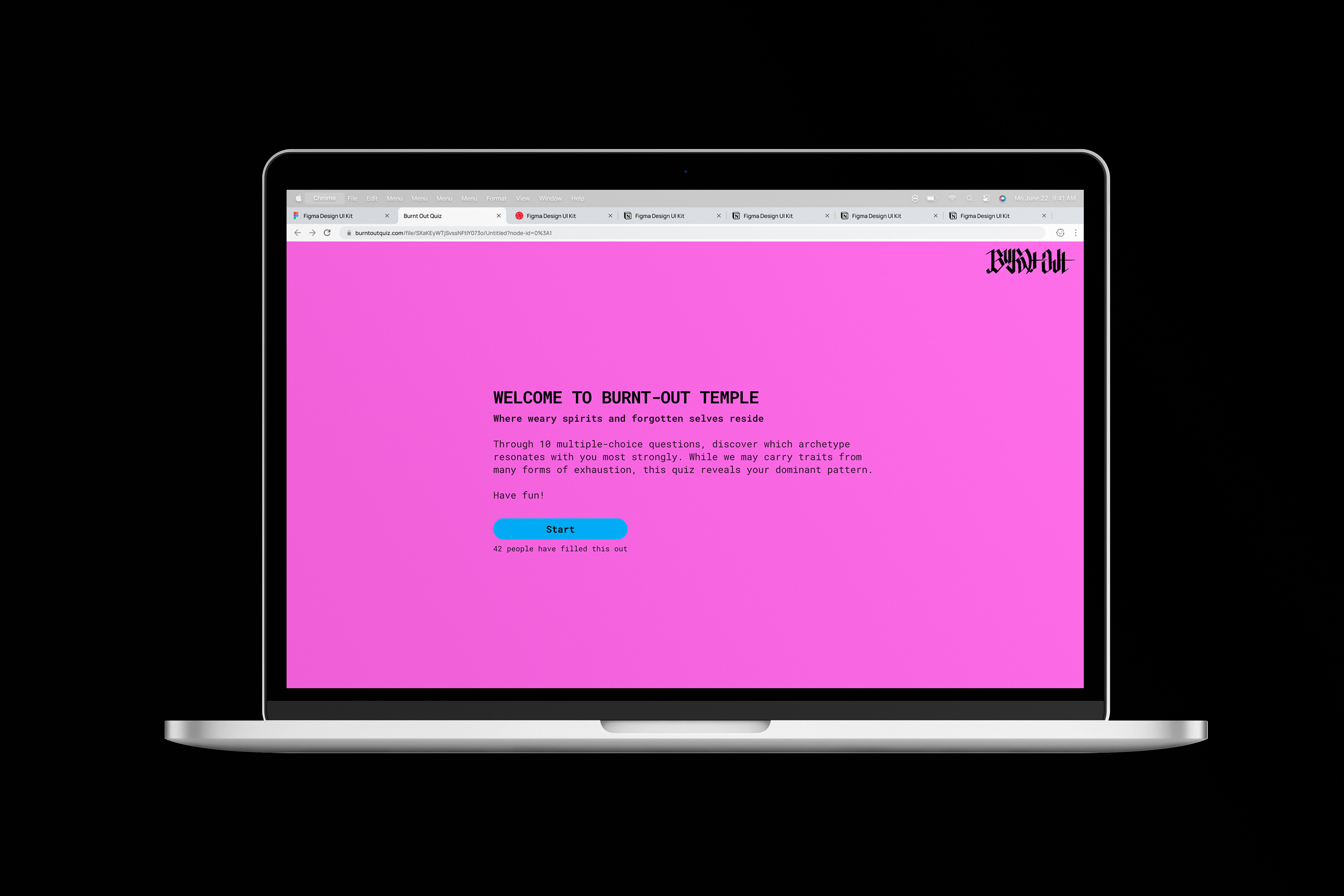
The quiz consists of 10 in-depth questions. The website includes a Welcome Page, 10 Question Pages, and 9 corresponding Result Pages.
Each Result Page features Characteristics, Root Causes, Psychological Impact, Strategies for Recovery, What to Look Out For, Hidden Strengths and How to Balance Them, Compatible Burnt Out Types, Incompatible Burnt Out Types, and Recommended Talismans.
STEP 2: Find Your Talisman
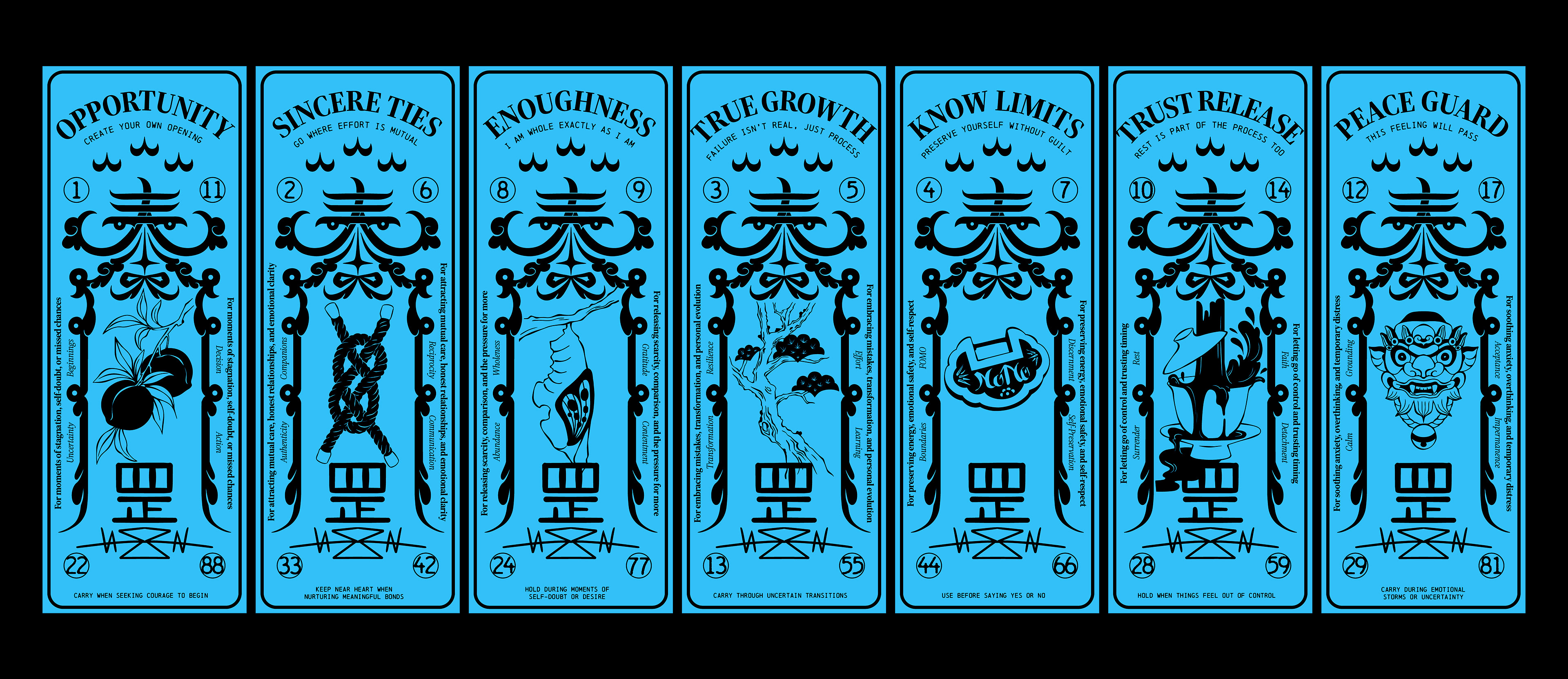
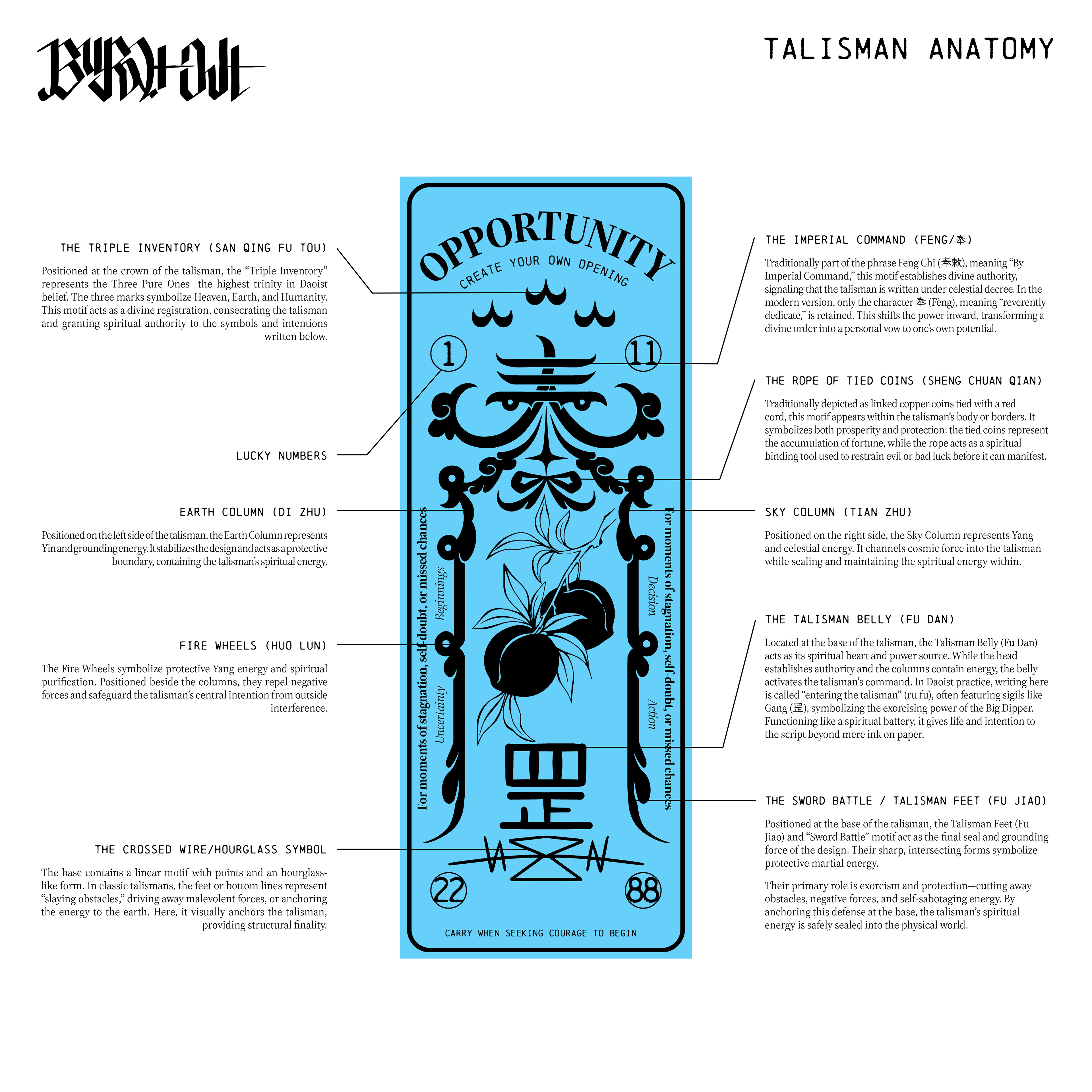
These pieces adapt traditional Daoist talisman elements into modern symbols of resilience. Originally engineered for protection and spiritual balance, they are reimagined by Burnt Out Temple as personal tools for burnout recovery and emotional healing. Classical talisman calligraphy is intentionally abstract and illegible, meant to be read only by spirits; I embraced this mystique, transforming the sacred linework into ornate, striking design elements that anchor personal intention.
The anatomy of the talismans is deeply respected. It has head and body. The head includes Triple Inventory. The body includes Sky Column, Earth Column, Fire Wheel, Rope of Tied Coins, Talisman Belly, Talisman Feet, and Sword Battle. The Talisman Stars are replaced with the symbol of each talisman.
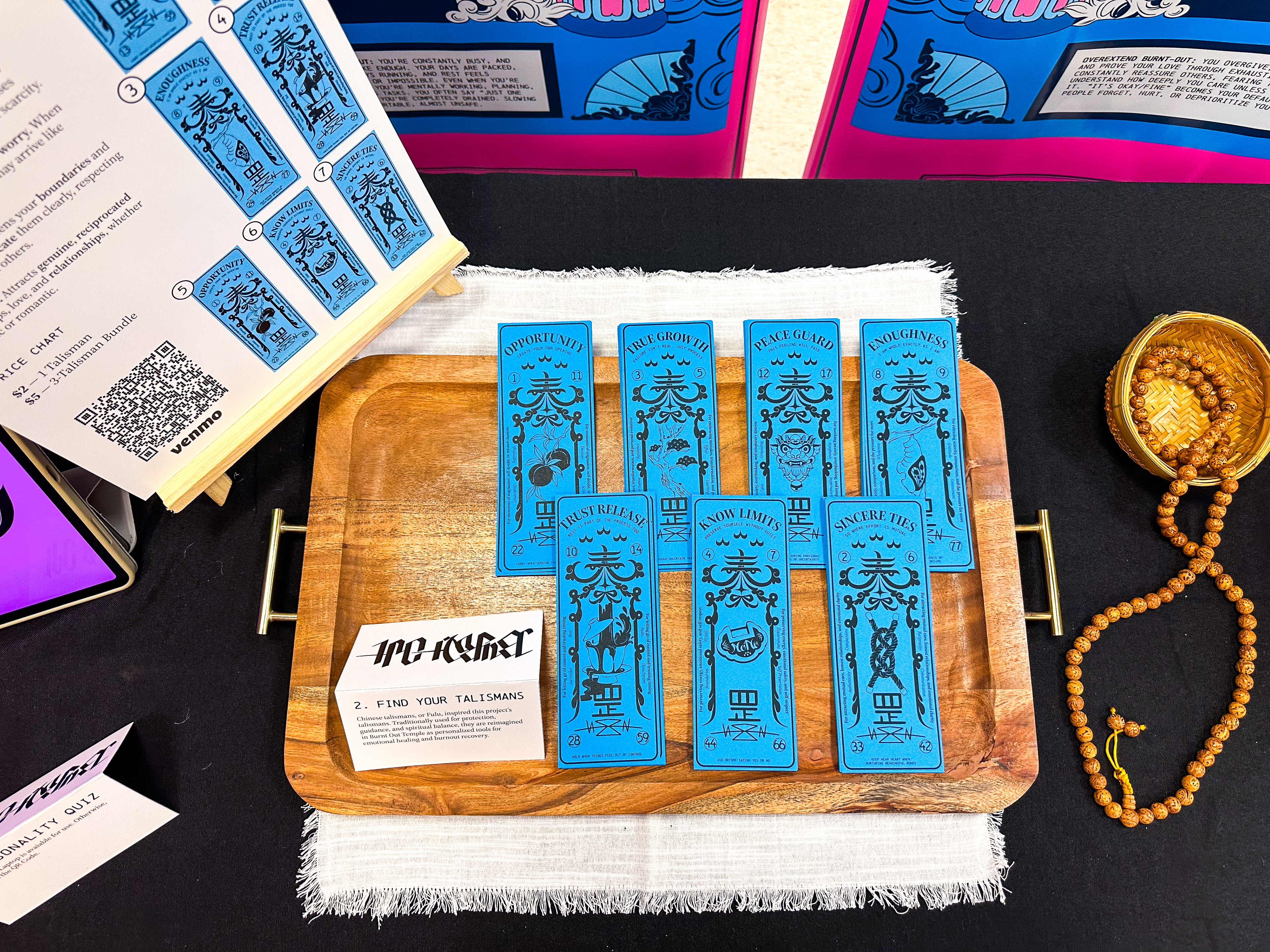
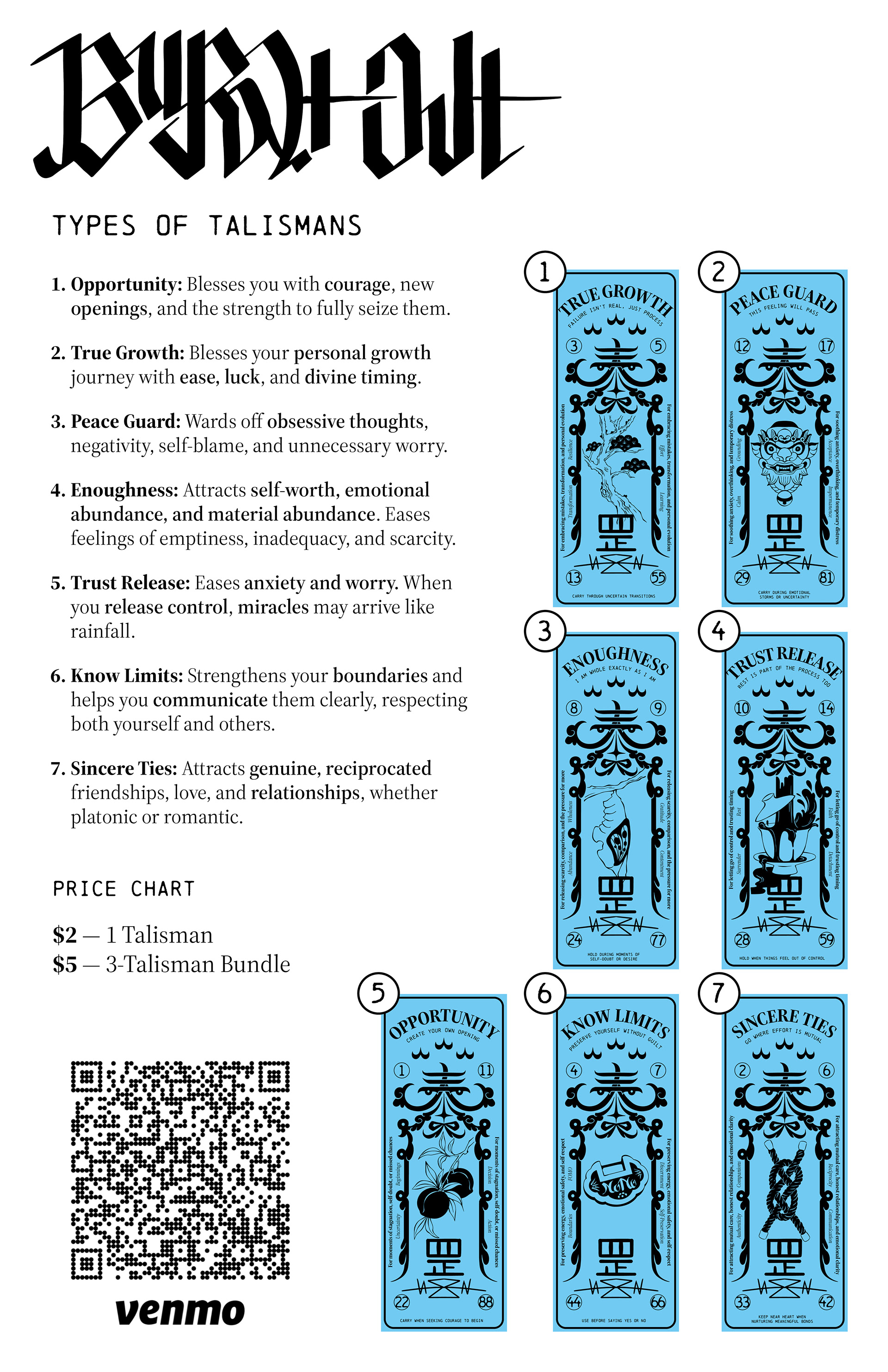
There are seven types of talismans: Opportunity, Sincere Ties, Enoughness, True Growth, Know Limits, Trust Release, and Peace Guard. Each talisman carries its own symbolic imagery rooted in cultural meaning. Opportunity is represented through peaches, symbolizing luck and new beginnings. Sincere Ties uses tied knots to represent mutual connection and lasting bonds. Enoughness is symbolized by the chrysalis stage, representing self-worth, transformation, and becoming. True Growth takes the form of a tree, symbolizing gradual growth through time and process. Know Limits uses a Chinese lock, representing protection and healthy boundaries. Trust Release is represented by an overflowing teacup, symbolizing surrender and emotional release. Peace Guard features the Nghê, which is a traditional Vietnamese sacred guardian creature associated with loyalty, vigilance, and protection.
STEP 3: Fortune Telling
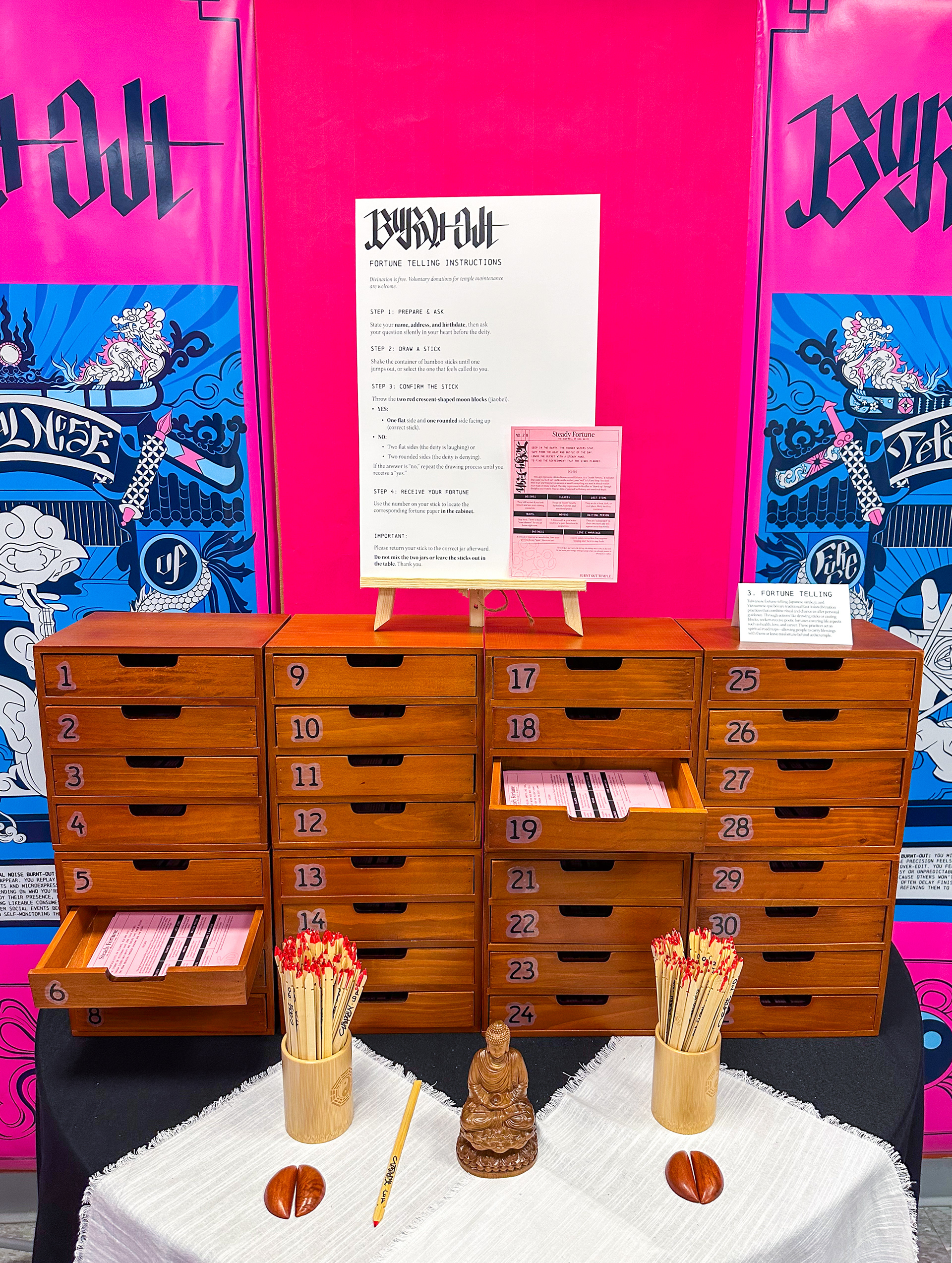
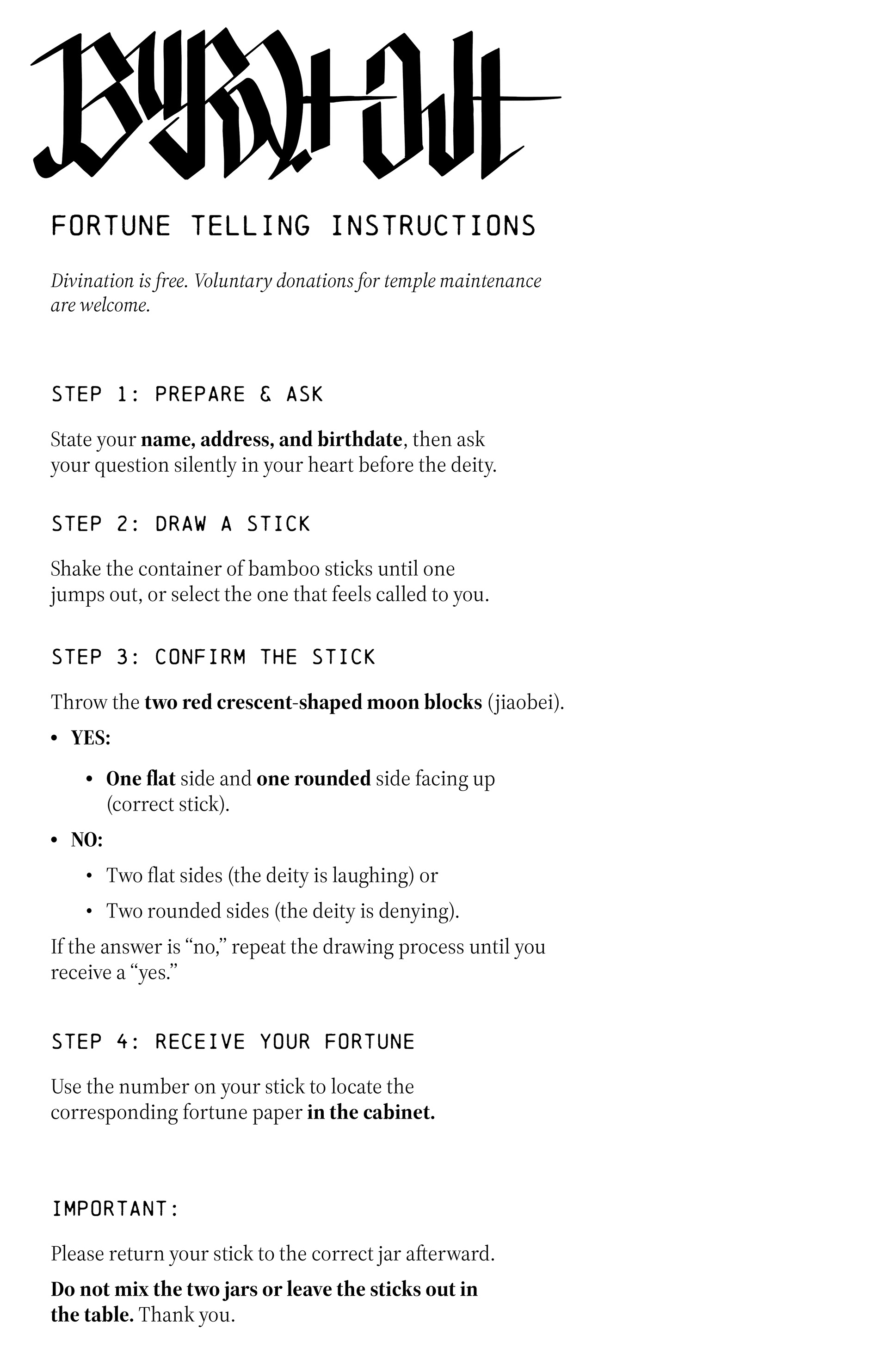
Taiwanese fortune-telling, Japanese omikuji, and Vietnamese quẻ bói are traditional East Asian divination practices that combine ritual and chance to offer personal guidance. Through actions like drawing sticks or casting blocks, seekers receive poetic fortunes covering life aspects such as health, love, and career. These practices act as spiritual roadmaps, allowing people to carry blessings with them or leave misfortune behind at the temple.
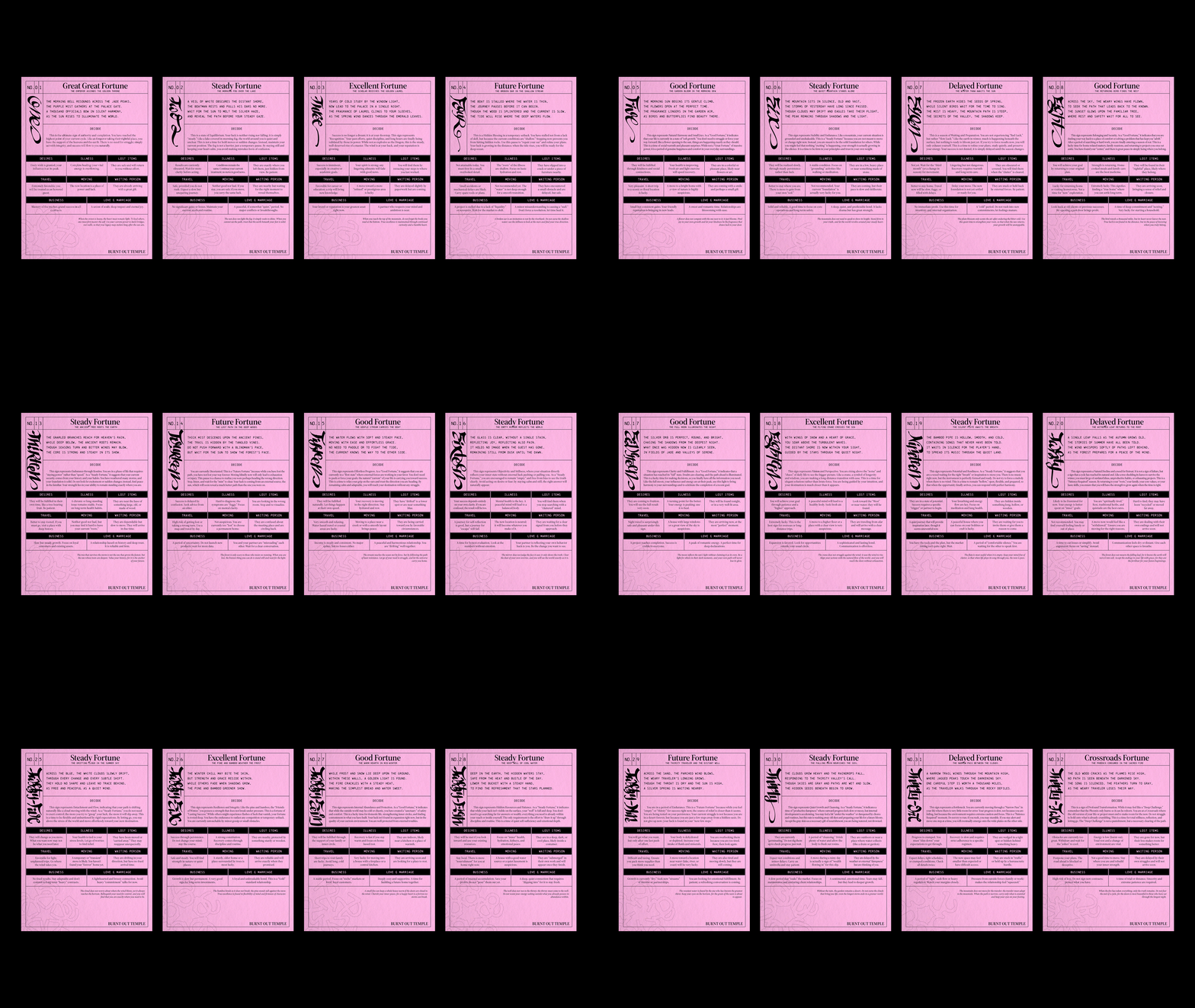
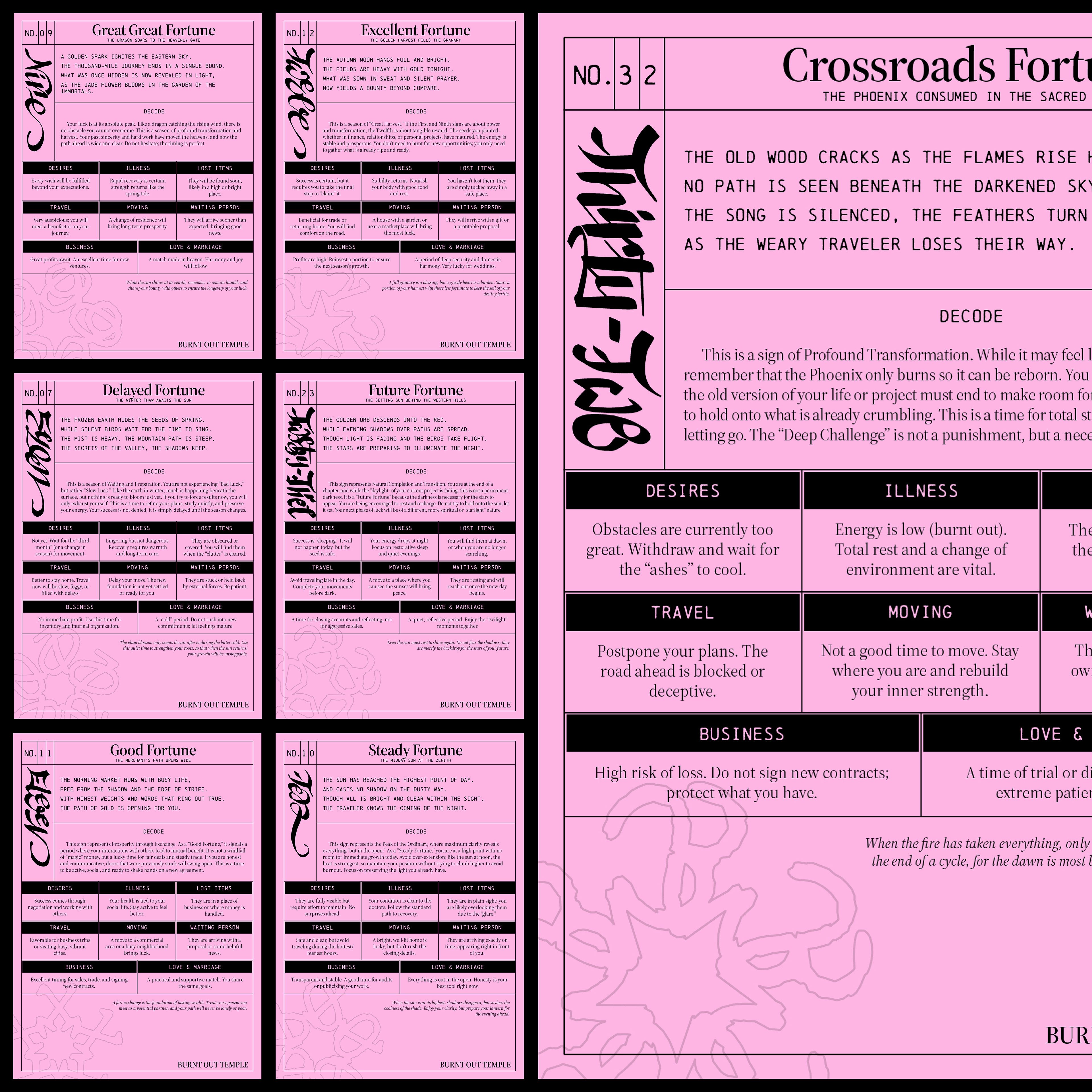
There are 32 fortune slips in total, divided into 7 tiers of luck: Great Great Fortune, Excellence Fortune, Good Fortune, Steady Fortune, Delayed Fortune, Future Fortune, and Crossroads Fortune. Rather than including “Bad Luck,” the system reflects the belief that something good still awaits us in the future. Difficult moments are viewed not as punishment, but as transitions within the natural cycle of life.
In one slip includes a short poem, the decipher, and specific advices in different areas such as Desires, Illness, Lost Items, Travel, Moving, Waiting Person, Business, and Love & Marriage.
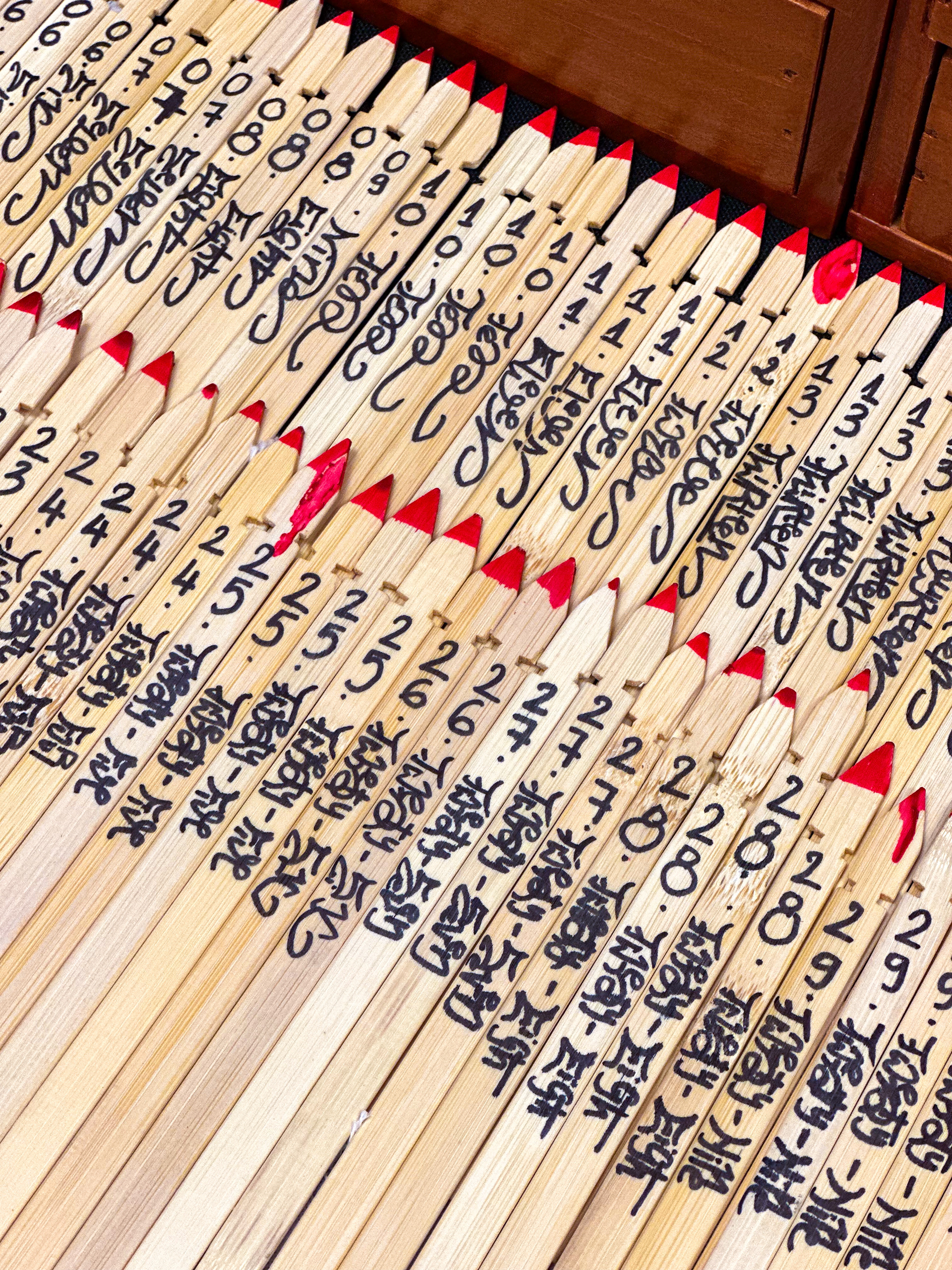
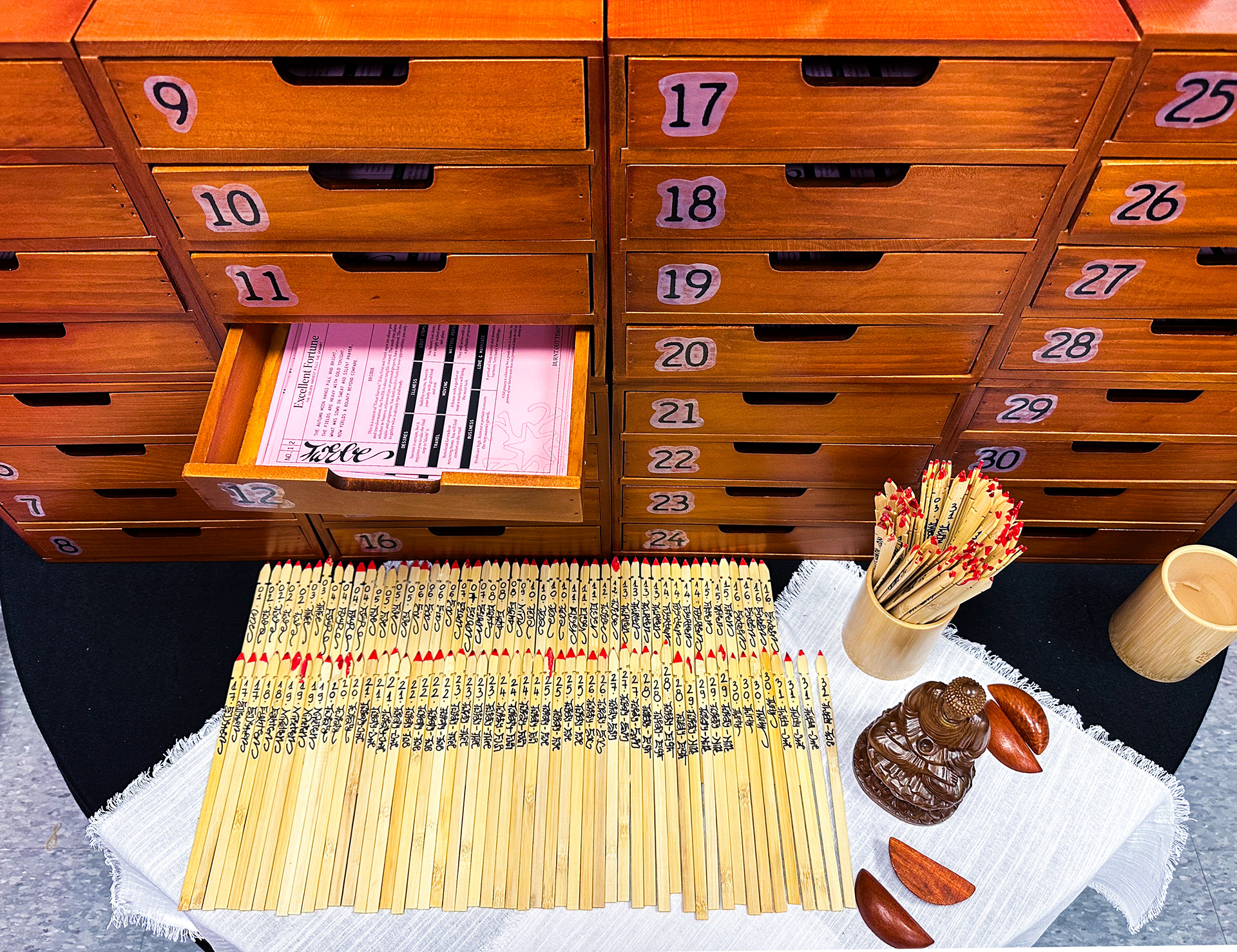
One aspect of this project that surprised me most was the heavy involvement of typography design. The “calligraphy” used throughout the fortune slips borrows the visual rhythm and brush-like accents of Mandarin calligraphy while remaining fully in English Latin characters. This approach makes the beauty of East Asian calligraphic aesthetics more accessible and inclusive, while respectfully bridging both cultures. Every letterform was hand-drawn to preserve the expressive and human quality of traditional calligraphy.
At the bottom-left corner of each slip are floral number seals inspired by Japanese temple stamps. Using Adobe Illustrator’s Repeat Radial tool, these numbered flower forms were created to add visual rhythm and ornamental detail.
On top of these deliverables, I also create a puzzle game. This game invites players to symbolically heal burnout by addressing its root causes, like Compassion Burnout learning to wear their own shoes, or Safe-Zone Burnout bursting their protective bubble. It encourages curiosity while offering simple, approachable solutions to complex mental health struggles.